Monday, February 13, 2017

Blog Post #4


Creatively Un-creative Writing


In 2011, American poet Kenneth Goldsmith coined the term "Uncreative Writing" in his book of essays, called Uncreative Writing:Managing Language in the Digital Age. Uncreative writing can take many forms, including writing screenplays for existing television shows and videos, creating essays comprised of pieces of other people's writings, and transcribing audio clips. In many of Goldsmith’s works, he often infers on the idea that “re-purposing a work is not plagiarism”, a theory that has brought much criticism along with it. These criticisms stem from where credit should be given. Re-purposed works have many different authors, and it becomes hard to tell who is the actual creator of the work. There are many different collaborators in a re-purposed work that all deserve credit for their part in the new piece. 


In the link below is a poem compiled of text that has been generated by our four tribe members in a group chat. The poem we created was composed of the audio we heard from three separate videos, a KurtCobain interview, Jimmy Fallon #MomTexts, and a history of rap with Jimmy Fallon and Justin Timberlake. Each member of our tribe typed into the chat bits and pieces of what we heard in these videos, and we composed them into what can really be describes as a poem of many things. The most interesting part of this work is that while simultaneously hearing the same audio feed, each member tended to chose the same words/phrases to type into the chat. This makes the poem a flow of words our brains interpret, intertwined together, creating a poem of our similarities of mind. 
https://docs.google.com/document/d/1nFqDHeQ5QIwByBSfgwME9HB11fiVcYhCn7cNecsWrDo/edit?usp=sharing

Saturday, February 4, 2017

Response to Bots & Self-Generating Texts


Whether you know it or not, there is a good chance that you have interacted with web robots at least once before, or even interact with them everyday. So what exactly is a “web robot”? These robots, commonly known as bots, are programs that run automated tasks. These bots create simple and complex works, typically with the purpose of generating what for humans would be time consuming and never ending works. However, many of these bots are often used for malicious reasons. For example, certain chat-bots are used for scamming purposes since many of these self-generating text bots can easily be confused for being actual humans writing the text. Programmers set up parameters for the bots to follow so the text they create follows grammar rules and speech patterns to make them sound more human-like.

ppp.PNG
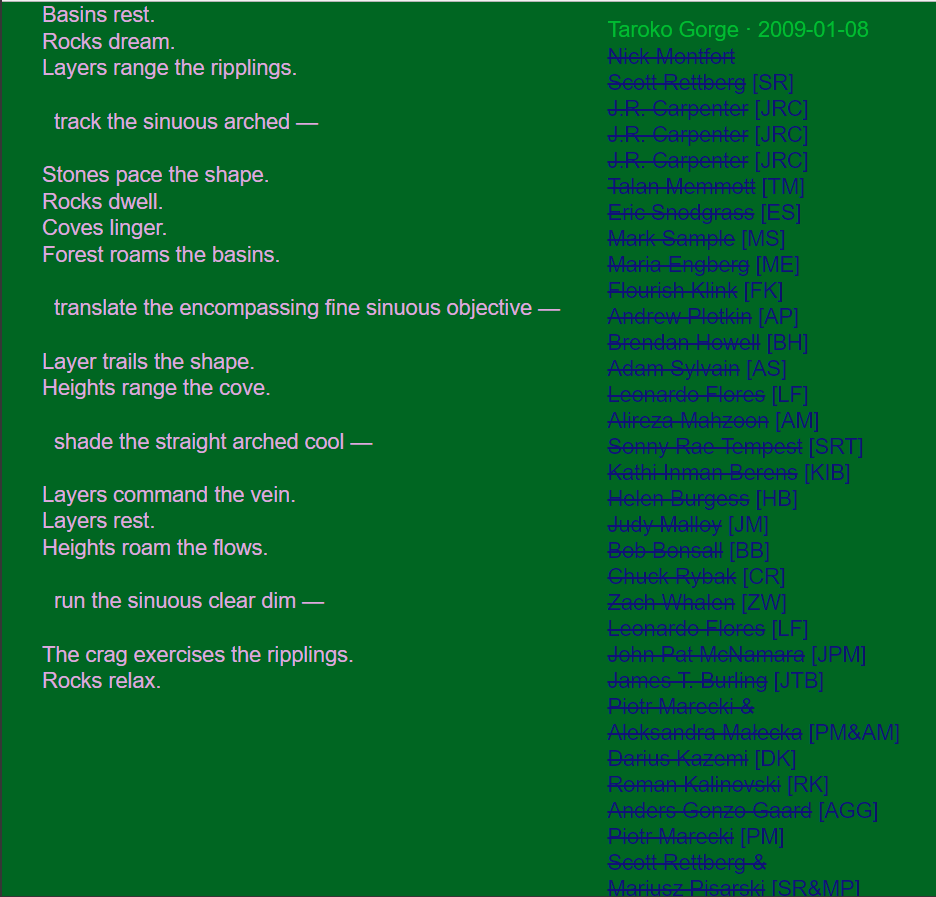
Taroko Gorge” is a self-generating poem created by poet/digital media artist Nick Montfort. The text is produced line by line scrolling down the screen, endlessly describing a nature scene. This work is written in a code which Montfort gives the public free permission to use, copy, modify, or distribute. His code has allowed many other authors create and publish their own works of self-generating text. These automated programs are different than other software because they produce content that humans can interact with or view from an artistic standpoint. They are also different because they do not create the same work more than once, text generating bots formulate text randomly every time. Even though the text these bots create is random, they still follow sentence structure and speech patterns.

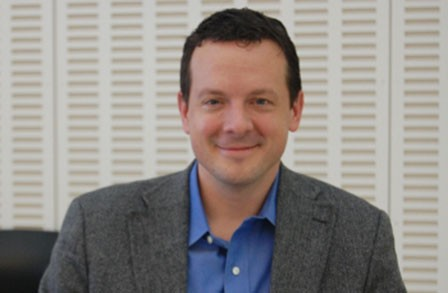
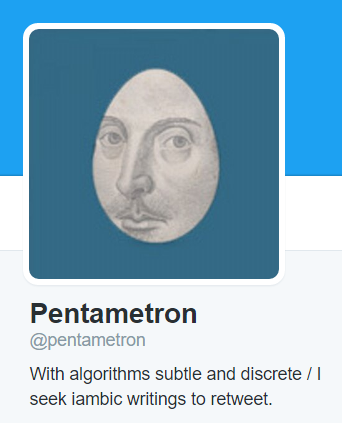
djifskmv.PNG Pentametron is a Twitter bot created by Ranjit Bhatnagar. Bhatnagar is also interested in working with language, technology, and sound materials, which helped the development of this bot. Essentially, this bot uses an online dictionary service to locate various tweets in iambic pentameter. The bot then holds that tweet until it detects another tweet with the same rhyming pattern, and retweets them both to create a rhyming couplet. For example, tweets in succession include, “up for whatever reason .. nothing new,” “been craving some Korean BBQ,” “here goes another unproductive day,” “I have an interview tomorrow, yay!” According to a statement by the Electronic Literature Collection, Bhatnagar commented on his Twitter bot saying, “as a sound artist who studied some linguistics, I’m interested in language as a material for fabricating new kinds of art".

Sunday, January 29, 2017

Rachel Heming -- E-Poetry


E-Lit, Digital Poetry, etc...


With technology advancing every day, developments are constantly being made in all kinds of areas. Many of the arts are being hybridized with these technological advancements, and it has paved the way for a myriad of possibility. Electronic literature is just one intersection of these two realms. The written arts are presented in a more visually captivating, user-interactive format. Looking more deeply at e-lit, one can find e-poetry.

E-poetry utilizes cutting-edge, digital formats to bring new life and meaning to poems. The technological aspect of it allow for a great diversity in the types of poems, from short, simple visual pieces to touch-interactive haptic poems. We looked at several different e-poems in class, but one that really stood out to me is titled "The Sweet Old Etcetera."


It is similar in name to E.E. Cummings's poem "My Sweet Old Etcetera." The reason for this is that this online work is composed of pieces of his writing. The viewer is presented with a bare scene, and by interacting with different parts of it, the scenery grows and changes. By the end, the viewer is presented with a beautiful landscape.


The style of the different sections mirrors the style of Cummings's poems. The use of parentheses in both leads to cleverly written works, and the whimsical, carefree tone of each evokes a sense of youth. The advantage of the e-poem is that it can utilize motion and sound in a way that classical poetry cannot.


Various sounds are produced when the reader interacts with the poem. They are similar to guitar chords and evoke a sense of remembrance and calm. Poetry in its classical form is meant to elicit some kind of response from the reader. E-poetry does this as well, but arguably has different ways for doing so. Everything about the image is also just text and color. The landscape is comprised by pieces of text. While a traditional poem could have this element, it could not unfold and progress the way this one does with user interaction. 

Everything from the unfolding of the landscape, to the animation of the words, to the soft yet striking music makes this piece a touching, powerful work of art. 

Created by: Rachel Heming


Thursday, January 26, 2017

                                 Poetry and the Digital World

Poems have shifted from simple paper and ink into an interactive experience for readers. In class we were given the opportunity to look at many different works of e-Poetry. To first understand the works the class had to understand what e-Poetry is. After learning that e-Poetry engages in aspects that digital media offers we looked at a piece titled “ask me for the moon”.

This piece involves poems describing the labor behind the scenes in a Hawaii resort. At first glance I felt that this topic would not catch my interest, however by the author immersing his work into the digital world he made it a piece that appeals to many more readers such as myself. I caught myself paying much more attention to what I read as I interacted with the piece. Clicking through I was much more immersed due to the author using Adobe Flash to make the work dynamic instead of stagnant text. The flash animations and the dark colors draw your interest in as you watch Waikiki slowly appear before you. The dark colors symbolizing the work done at night and behind close doors to keep guests happy only enforce this notion that is already being made throughout the poem. Messages and themes of the poems can be conveyed much stronger with the sound and visual effects that the digital world offers.


The verses of the poem appearing and disappearing forces readers to actually pay attention as they read through the story. This is what makes e-Poetry much more interesting than normal poetry. e-Poetry forces you to think and interpret what is going on throughout the poem. I feel that e-Poetry is a better way to present new poems due to their interactive aspects. These poems appeal to an audience outside of those who will recreationally read poetry. e-Poetry is a step in the right direction for digital literature.