Thursday, January 26, 2017

So What Exactly is E-Poetry?

                To understand E-Poetry, we have to first get a grasp on how to define E-poetry. One thing we have learned from any other Electronic literature is that it is very difficult to set a concrete definition for what exactly E-Poetry is. However, we can generalize a definition for E-Poetry as being works of electronic literature that approaches poetry through the usage of computers and other digital components. These electronic poems range from a more simple text generator, to more complicated interactive poems that create themselves, and tell a customized story for everyone who reads it.

 One of the more simple poems is called “Puddle and Paddle” by Neil Hennessy. This E-Poem is a kinetic poem, where the words change and are animated as the words they are displaying. One of the key aspects to this poem is the animation of the words within the poem itself, as is the case with many of the examples of E-Poetry we have viewed over the semester.
              
  Another example of E-Poetry we have analyzed this year is a piece called “Sydney’s Siberia” by Jason Nelson. I found this piece particularly interesting because it is an infinite click and read poem. What this means is that the poem you are reading is never ending, but also is different for every single users who navigates through it. Most poems are thought of as lines on a paper with a certain rhyming scheme, but Sydney’s Siberia is different. The poem begins as an image, and zooming in on the image brings up an entire painting of new images, each with its own separate poem on it. From all the examples we have viewed so far, I definitely enjoyed and interacted with this individual piece the most, and would highly recommend it to anyone interested in electronic literature.
A Selection of the never ending, interactive poem "Sydney's Siberia"

                I see electronic literature, specifically E-Poetry, as an excellent way for human expression using traditional poetic methods, but utilizing an ever advancing technology to coincide with us as we as humans evolve with it. E-Poetry has introduced a new, digitized, and creative turn to poetry that no pen and paper will ever be able to equal.

Reaction to E-Poetry


As an assignment for 01/20/2017, our class had to interact with a work of electronic poetry entitled “Public Secrets” by Sharon Daniel and Erik Loyer. This piece contains testimonies of women imprisoned within the central California penal system, documented by Sharon Daniel. These women share their experiences inside the facility, and narrate their thoughts and feelings about their lives behind the walls.


justicee nowww.PNG

In order to record and publish these hidden stories, Daniel had to be granted authorization as a legal advocate through a human rights organization called Justice Now. This is a non-profit organization which strives toward a prison reformation/anti-prison movement. The common goal of this group is to construct an end to all forms of gendered violence within state prison systems. They have collectively transformed the lives of many people inside of California’s women’s prisons through programs that build community power and challenge violence within the system.

jus.PNG

As I navigated through this website, I was able to read and listen to the pain, suffering, and humiliation that these women are subjected to daily. For example, a woman named Valerie Biedler gave a statement of her opinion on sexism. She explains how she witnessed a man and woman being charged for the same crime, (the woman having never been in trouble, and the man having been in trouble before) and the man received sixteen months while the woman received five years. Biedler quotes the judge saying, “to teach her a lesson” was the reasoning for this difference in sentencing, however, she believes it is because women are "easier to manage" than men in the prison system.

This work of electronic poetry has a powerful impact on its viewers because of its effective use of pathos. As viewers click on the randomly generated quotes they can read the transcripts of the women’s interviews as well as listen to their voices. These voice recordings allow the viewer to not only hear, but feel the anger, sadness, confusion, and distress these women are enduring because of their subjection to inequality and violence in the prison system.


By: Hunter Rose Myers

Response to E-Lit

Our tribe was assigned to study Electronic Literature, and thanks to the Electronic Literature Organization, we have learned that e-lit “refers to works with important literary aspects that take advantage of the capabilities and contexts provided by the stand-alone or networked computer.” A simple definition is literature that is “born-digital.” Electronic literature is not a digitized medium because it was originally created using technology. Examples include stories and poems that are generated through online code, novels that take the form of blogs or emails, and pieces accessible through only touch media such as tablets, smartphones, or other touchscreen devices.

We are nowhere near experts on this, though, so to further our understanding we explored some e-lit and responded to it. For example, Dinty W. Moore's, “Mr. Plimpton’s Revenge.” This is not a typical essay you would read in English class, though; it was created with Google Maps. This style is appropriate because the story is narrated by Moore, who is traveling through time, documenting the locations of his interactions with author George Plimpton.
The intrigue of this piece primarily comes from its composition. The viewer is presented with a list of locations containing points of Moore and Plimpton’s interactions that they use to navigate through the story. Each location on the map introduces another part of the story. It is almost like reading an interactive chapter book. For example, he includes destinations such as the University of Pittsburgh, the Harrisburg Airport, and Manny’s Music Store. Along with entertainment, Moore chose to create this essay to capture the message of his deserved fate; he administered revenge upon himself.

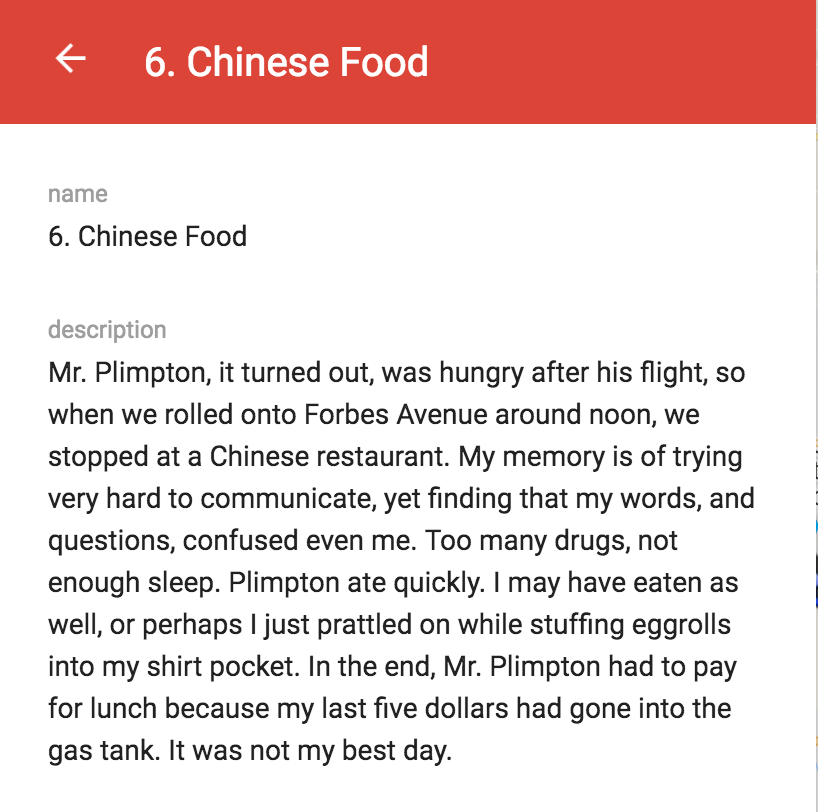
The story begins in Pittsburgh, where Moore, an undergraduate student, is designated to chauffeur Mr. Plimpton to the University of Pittsburgh. Strung out from a long night filled with weed and booze, Moore retrieves Plimpton from the airport in his hunk of junk car. To humiliate himself further, Moore could not even pay for his lunch when they stopped for Chinese food... so guess who paid?

This is only the beginning of a list of many coincidental encounters between Moore and Plimpton, each as uncomfortable for Moore as the first. The story spans several years, and culminates in a final scene of humiliation for Moore. 

The story also takes the reader through many different locations. The use of Google Maps to illustrate this makes it easy for the reader to follow the story's many twists and turns.


A thoroughly humorous and entertaining piece, Mr. Plimpton’s Revenge is an excellent introduction to electronic literature.